
Soiling & cleaning gaps
Industrial dust, bird droppings, and infrequent cleaning reduce irradiance reaching modules. The impact depends on site conditions.
FOR OPERATING SOLAR ASSETS
Investigate generation gaps, understand financial impact and prioritise corrective action for your commercial or industrial rooftop.
Request a plant assessment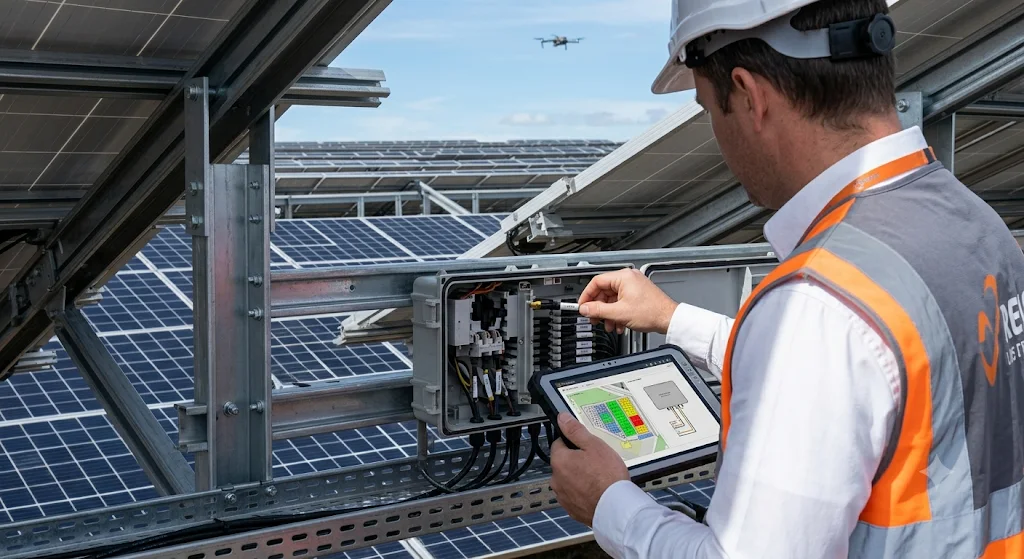
An assessment investigates the relevant categories of loss at your facility and their financial effect.
Industrial dust, bird droppings, and infrequent cleaning reduce irradiance reaching modules. The impact depends on site conditions.
PID, microcracks, hotspot formation, and product defects accelerate beyond modelled degradation curves — especially in hot, humid climates.
New structures, HVAC equipment, or vegetation not accounted for in the original design create partial shading that monitoring dashboards often mask.
Clipping, thermal derating, loose DC connections, string mismatch, and misconfigured MPPT channels reduce output without triggering obvious alarms.
Wrong PR baselines, sensor drift, and misconfigured SCADA make a underperforming plant appear healthy on paper.
Missing PR guarantees, undefined reaction times, and no corrective maintenance SLAs allow chronic underperformance to persist year after year.
Every assessment follows a structured engineering framework — from generation data to board-ready financial conclusions.
Verify installed DC/AC capacity, establish weather-normalised performance benchmarks, and compare actual generation against your P50 design baseline using Performance Ratio and specific yield analysis.
Reconcile actual output against the ROI, IRR, and payback assumptions in your original business case. Quantify revenue at risk in ₹/year — not just kWh variance.
Audit O&M contract scope, cleaning schedules, work order history, spare parts readiness, and SLA compliance against manufacturer recommendations and industry best practice.
Identify underperforming equipment through SCADA analytics, infrared thermography, sample IV curve testing, inverter event log review, and targeted site inspection.
Deliver a prioritised remediation roadmap — quick wins, medium-term fixes, and structural improvements — each with estimated kWh recovery, cost, and payback on corrective capex.
We request as-built drawings, commissioning reports, 12–24 months of inverter/SCADA data, utility bills, O&M contracts, and your original financial model.
Engineers normalise generation against irradiance, calculate PR trends, segment losses by inverter and string, and flag financial variance against your approved business case.
On-site verification with thermography, electrical testing, and physical condition assessment — focused on the highest-impact findings from desktop analysis.
You receive an independent report with fault register, ₹/year revenue impact, and a prioritised optimisation plan. Remediation execution is available separately through TerraFlux EPC if required.
Scope, data availability and independence arrangements are agreed before work begins. The assessment is for facility owners, finance teams and energy managers; any remediation through TerraFlux EPC is a separate engagement.
Share what you already have. Detailed data requirements, pricing and timing are established during the project discussion.
Discuss your existing plant